Burnt Ordinary: A Revolutionary War Landmark in Nottoway County
Long before Nottoway County was officially formed in 1788, one of the most important crossroads in the region was a place known as Edmundson’s Old Tavern, sometimes called Edmundson’s Ordinary. Located along one of the main travel routes through Southside Virginia, the tavern served travelers, merchants, soldiers, and local residents during the colonial era.
Today, the site is better remembered by another name: Burnt Ordinary.
The story of Burnt Ordinary is tied directly to the final years of the American Revolution. In 1781, Virginia became the center of military operations as British forces under General Charles Cornwallis moved across the colony. Among his most feared commanders was Lieutenant Colonel Banastre Tarleton, leader of the British Legion, a fast-moving cavalry force known for its aggressive raids and devastating attacks on Patriot communities.
As British troops swept through Southside Virginia, local settlements found themselves in the path of war. According to local tradition preserved by historian W.R. Turner in Old Homes and Families of Nottoway, Tarleton’s cavalry descended upon Edmundson’s Ordinary during one of these raids. The tavern and surrounding settlement, sometimes referred to as Morgansville, were burned during the attack. The destruction left such a lasting impression that the community became known thereafter as Burnt Ordinary.
The raid was remembered for generations not only because of the destruction itself but because of its connection to Peter Francisco, Virginia’s legendary Revolutionary War soldier. Local tradition holds that Francisco was captured during the British sweep through the area. Whether every detail of the story can be verified today, the event became deeply rooted in local memory and helped link Nottoway County to one of the most celebrated figures of the Revolution.
In the eighteenth century, an “ordinary” was more than just a tavern. It served as an inn, restaurant, meeting place, stagecoach stop, and center of community life. News traveled through such establishments, business was conducted there, and travelers often relied upon them for food and lodging. The destruction of an ordinary was not merely the loss of a building—it was the loss of a vital gathering place for an entire community.
Following the war, the settlement gradually disappeared from maps and memory. The buildings vanished, roads shifted, and the community that once stood there faded away. Yet the name Burnt Ordinary endured, preserving a reminder of the violence and uncertainty that accompanied the struggle for American independence.
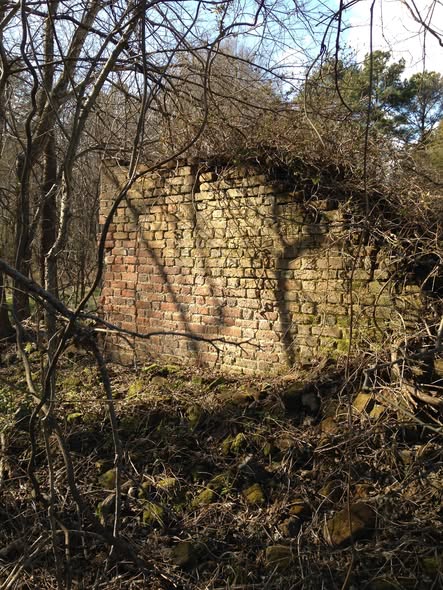
Today, little remains of the original settlement. Portions of the site survive on private property (the image above are remnants of a brick wall), and local tradition speaks of scattered brickwork and the remains of old foundations hidden among the trees. Though the tavern itself is gone, its story remains an important part of Nottoway County’s Revolutionary War heritage. As America commemorates the 250th anniversary of the Declaration of Independence, Burnt Ordinary serves as a reminder that the Revolution was not fought solely in famous cities and battlefields. It was also experienced in rural communities like this one, where ordinary citizens found themselves caught in the path of extraordinary events.
The story of Burnt Ordinary connects modern Nottoway County to the founding of the nation and preserves the memory of a place where the American Revolution left its mark upon the landscape.